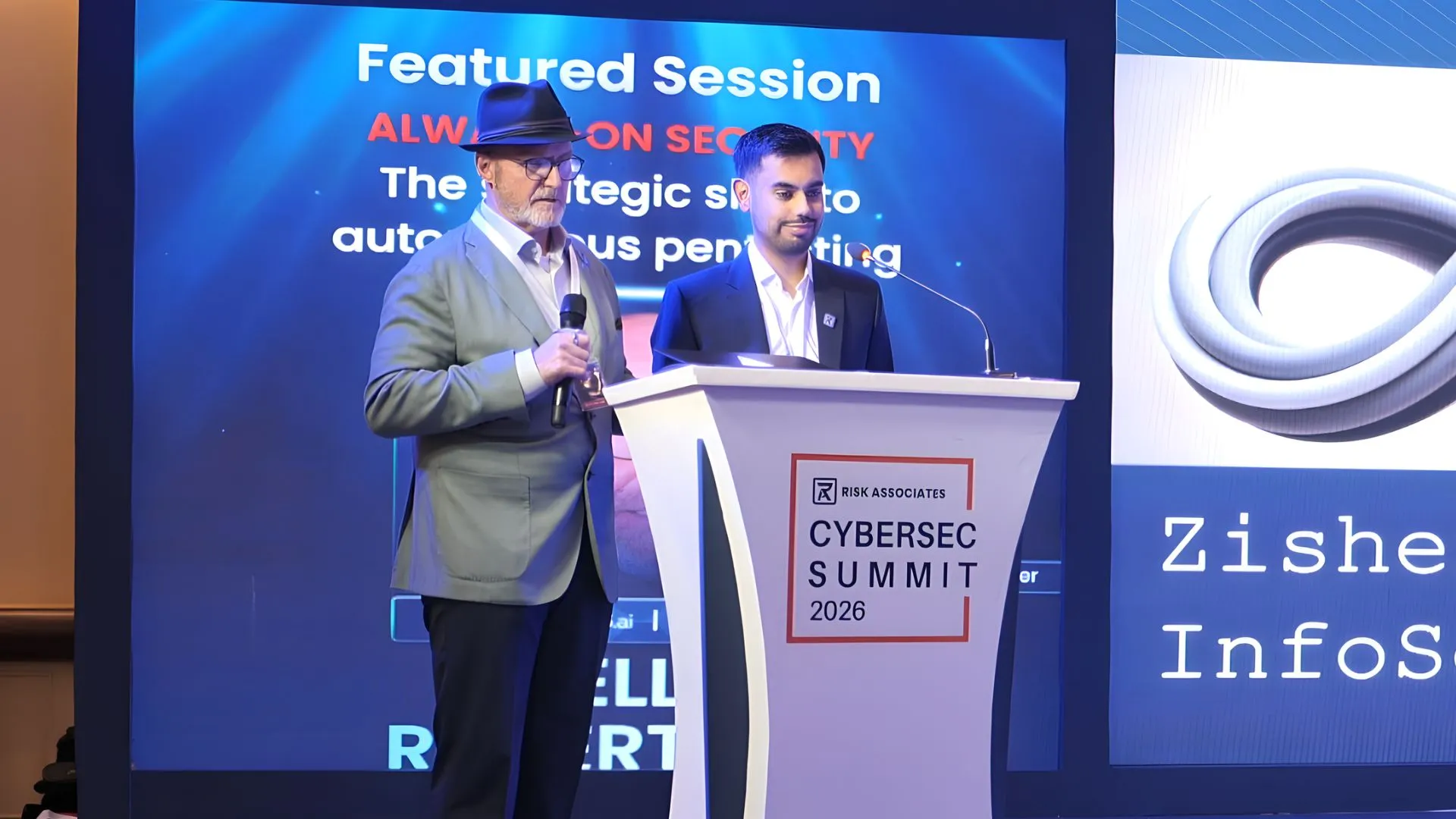
Presented by Kelly Robertson & Hussain Zaidi
RA CyberSec Summit 2026, organised by Risk Associates, convened cybersecurity leaders, enterprise decision-makers, and technology experts to explore the evolving dynamics of cyber resilience, governance, and proactive security strategies. The summit was held across two major cities in Pakistan, taking place on 2 February 2026 at the Marriott Hotel Karachi – Grand Ballroom, followed by the Islamabad edition on 4 February 2026 at the Air University Auditorium.
Among the featured presentations, Kelly Robertson and Hussain Zaidi delivered an insightful session titled “Always-On Security: The Strategic Shift to Autonomous Pentesting.” The presentation examined how organisations must move beyond traditional, periodic security testing and adopt continuous validation models to stay ahead of modern cyber threats.
The speakers highlighted a critical challenge facing enterprises today: conventional penetration testing is typically conducted once or twice a year, leaving long gaps where new vulnerabilities may remain undetected. In contrast, autonomous pentesting technologies enable organisations to continuously assess their security posture and identify exploitable attack paths before adversaries can take advantage of them.
A key highlight of the presentation was a live demonstration of the Horizon3.ai NodeZero® platform, showcasing how autonomous pentesting can transform how organisations identify and remediate security risks.
NodeZero is designed to autonomously perform penetration tests across enterprise environments, enabling organisations to uncover real attack paths, validate exploitable weaknesses, and prioritise remediation efforts. Unlike traditional testing approaches that rely on manual scripts and scheduled engagements, the platform runs continuous pentests that safely simulate attacker behaviour across networks, systems, and applications.
During the demonstration, attendees were shown how NodeZero navigates enterprise environments by identifying vulnerabilities, chaining weaknesses together, and demonstrating how attackers could move laterally across systems to reach critical assets. The platform provides real-time visibility into attack paths, enabling security teams to understand how vulnerabilities combine to create real organisational risk.
The solution also provides clear remediation guidance and prioritised risk insights, helping organisations focus on fixing the weaknesses that pose the greatest potential impact. Once remediation steps are implemented, NodeZero enables security teams to immediately verify whether those fixes have successfully eliminated the risk.
Explaining the importance of continuous security validation, the presenters emphasised that modern attackers rarely rely on sophisticated exploits alone. Instead, they often exploit weak credentials, misconfigurations, exposed data, or poor security controls to gain access and move within enterprise environments.
The NodeZero platform addresses this challenge by enabling organisations to adopt a continuous “find, fix, and verify” security cycle, helping security teams maintain constant visibility into their risk posture while strengthening organisational resilience.
The presentation resonated strongly with CISOs, security leaders, and enterprise technology professionals attending the summit, highlighting how autonomous pentesting can significantly improve the speed and effectiveness of vulnerability discovery and remediation.
As emphasised throughout RA CyberSec Summit 2026, organisations must shift from reactive defence models to continuous security validation frameworks that actively test the resilience of their environments.
The session ultimately reinforced a central message of the summit: in today’s rapidly evolving threat landscape, security must operate continuously rather than periodically, ensuring that organisations remain prepared against emerging cyber risks.
Let's begin your first NodeZero pentest in minutes
Book a Demo Now!
